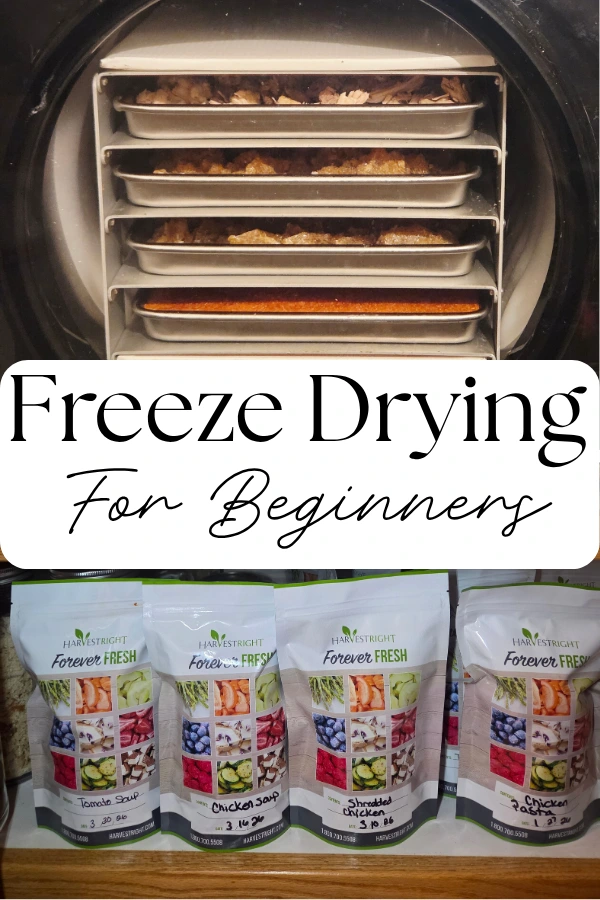

Before I ever owned a freeze dryer, I was already dehydrating food for long-term storage and making dehydrated meals for Curtis and me to take camping. And every time, the same thing happened. I’d pour boiling water over a meal at camp, wait, and it would come back rubbery. It never returned to what it had been.
I wanted to know if there was a better option.
The price is what made me research freeze drying for beginners so carefully before buying anything. If you’re doing the same thing right now, I completely understand. I didn’t want to spend that much on a machine if it was going to give us the same result as dehydrating. I needed to know it was worth switching.
Spoiler alert: I will never go back to dehydrating, unless it’s to make powders like garlic powder and onion powder, or fruit leather.
Freeze drying can feel really intimidating, but I’m here to take the intimidation out of it so you can get started with confidence. Whether you want a pantry that goes wherever you go or ready-to-eat meals for busy days and camping trips, this is everything I wish I’d known first.
Freeze Drying for Beginners: The Short Version
A home freeze dryer freezes your food, then uses a vacuum to pull the moisture out until the food is dry enough to keep in the pantry instead of the freezer. For beginners, it’s simpler than it looks: run the test cycle from the manual, start with low-fat, low-sugar foods, let the machine finish completely, and seal the food right away.
Quick answer:
- Start with: fruit, vegetables, and lean cooked meat
- Avoid: high-fat foods, which go rancid, and very sugary foods unless you dilute them with water
- Expect: about 20 to 40 hours per batch, longer for dense or sugary foods
- Store it: in an airtight container for the short term, or with an oxygen absorber in a vacuum-sealed jar or mylar bag for the long term
Which Freeze Dryer I Use
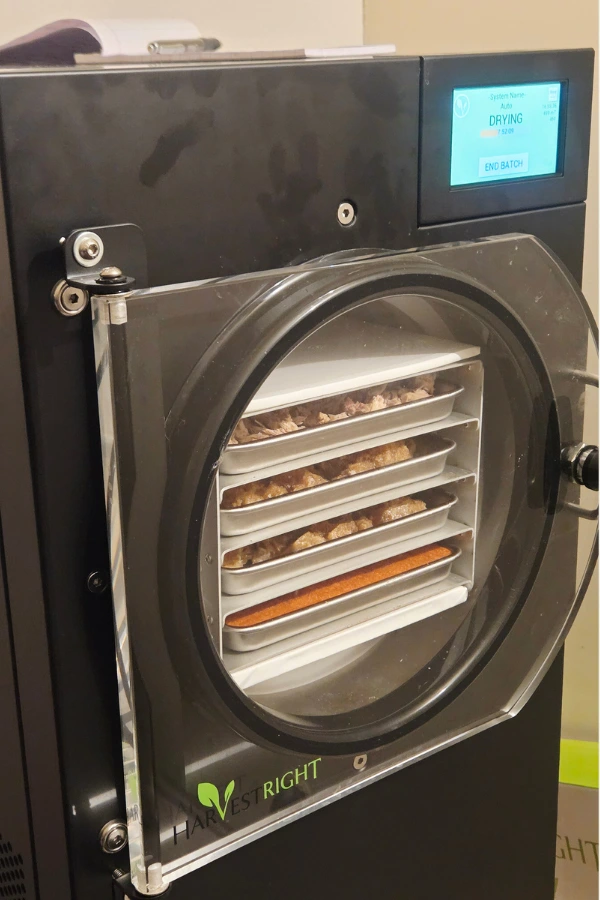
I have the Harvest Right freeze dryer in the small size. Good or bad, I can’t say anything about the other brands, because I haven’t used them and I can’t give you an honest answer. I will say I absolutely love Harvest Right. I haven’t had any issues, and it works wonderfully.
Before buying, I read that Harvest Right was the most popular brand and had really great reviews. That’s why we went with it.
How a Freeze Dryer Works
The freeze dryer freezes the chamber, including everything on the trays. Then it creates a vacuum that pulls the moisture out of the food. Sensors keep track of how frozen the food is and how much moisture is left. Once they can’t sense any more moisture, the cycle finishes.
With the moisture gone, your food can be stored in the pantry instead of the fridge. Wild, I know! Instead of a freezer full of frozen veggies, meats, and meals, it all goes on a shelf. Stored in an airtight container with an oxygen absorber, it lasts for months. Add an oxygen absorber and vacuum seal out the air, and it can last for years.
What You Can Freeze Dry
A freeze dryer can preserve almost anything. I was really impressed when I first looked into what we could and couldn’t freeze dry, and I still am. My freeze dryer has been running almost every day since I set it up.
So far I’ve freeze dried:
- Fruit, like strawberries and bananas
- Veggies
- Meat, like turkey
- Eggs
- Broth
- Drinks
- Full meals
- And so much more
For the full list, plus a time chart for each food, see the best foods to freeze dry at home.
What I’ve Learned Not to Freeze Dry
Not everything I’ve freeze dried has turned out.
One time I tried to freeze dry pure lemon juice. It caked onto the bottom of the tray, and I honestly couldn’t get it off without rehydrating it. I found out you have to freeze dry the pulp with the juice to get a nice powder.
I’ve also tried turkey bacon. It tasted amazing as a crunchy snack straight out of the freeze dryer. But after I packaged it for long-term storage, it went rancid. It had a weird, very bad taste I couldn’t fix. I’m assuming the little bit of fat in the bacon is what made it go bad.
I tried freeze drying whole uncooked eggs, too. The yolk didn’t dry completely, and it went bad because there was still moisture in the middle. If you want to freeze dry eggs, whisk the yolks and whites together, or separate them and whisk each on its own, so they dry all the way through.
And I’ve tried things with too much sugar. They puffed up into a big sugary mess. If you want to freeze dry something very sweet, dilute it with water first so the sugar doesn’t puff up and go crazy inside your machine.
In simple terms: you can freeze dry almost anything that doesn’t have a lot of fat. The water leaves, but the fat stays, and it can go rancid in storage. If something has a lot of sugar, dilute it with water. Avocados are the exception. They’re high in fat, but guacamole freeze dries beautifully.
Can you freeze dry raw meat and eggs?
Yes, but freeze drying doesn’t kill bacteria. It just puts them to sleep until moisture comes back. Utah State University Extension says raw meat, seafood, and eggs have to be fully cooked before you eat them. Cook them before you freeze dry, or cook them after you rehydrate.
The Rehydration Process
This part will completely blow you away. Everything I’ve rehydrated tastes like it did fresh, and it only takes a few minutes. You can use hot or cold water, too. That one surprised me, because the food I dehydrated could only be rehydrated with boiling water, and it never came back to its original form.
Hot water rehydrates faster than cold. Cold water still works within a few minutes, depending on what you’re rehydrating.
If you want the full side-by-side, I explain it in simple terms in dehydrating vs. freeze drying.
How to Freeze Dry Food at Home, Step by Step
Just looking at a freeze dryer can feel intimidating. I’m going to tell you right now: it’s way easier than you think. Here’s the whole process the simple way.
- Set up the machine. Harvest Right sends step-by-step instructions for hooking everything up.
- Run your first cycle. The manual spells this out. Do it before you put any food in.
- Pick your first foods. Choose things with very little sugar and no fat while you get the hang of it. I did a little of everything for my first batch, some veggies, some fruit, and some meat, because I wanted to see how different foods behaved.
- Decide whether to pre-freeze. You can freeze your food ahead of time to shorten the cycle, or put it in fresh and let the machine freeze it. Either works.
- Press start and wait. A message will tell you to wait 15 minutes before loading your food.
- Load the trays. After 15 minutes, put your food in, close the door, close the drain valve, and press continue.
- Let it freeze, then dry. The machine freezes everything first, then starts drying. Drying takes the longest. If the sensors still detect moisture, it adds extra dry time on its own.
- Release the pressure. When the screen says complete, open the drain valve to release the pressure. The door won’t open until you do.
- Check every piece. There should be no moisture left anywhere. If you find any, press extra dry time.
- Take your food out and defrost. Seal your food right away, then press defrost to get the machine ready for the next batch.
That’s it. You’ve finished your first freeze dried batch. Wasn’t that simple?
What If You’re Not Home When the Cycle Finishes?
This was my biggest worry with my very first batch.
I’d loaded the freeze dryer hoping it would finish before Curtis and I had to go into town. It didn’t. I knew I wouldn’t be back when the cycle ended, and the manual says the machine keeps the trays warm for 4 hours after it finishes. So my question was: what happens after 4 hours? Is everything I just put in there going to go bad?
Thankfully, I found the answer without learning a hard lesson. We got back from town a full day later, and the machine was still holding everything airtight. The food was still perfectly preserved.
All I had to do was press the warm trays button, wait until it started counting down from 4 hours, then release the pressure and finish like normal.
So when the manual says you have 4 hours to remove your food, it doesn’t mean your food goes bad after that. It just means you’ll need to rewarm the trays before you take it out.
What happens if you leave food in the freeze dryer too long?
In my experience, nothing bad, as long as the door stays closed. My machine held the vacuum for a full day after the warm-tray window ended. Press warm trays, let it start the countdown, release the pressure, and carry on.
Why you should warm the trays before taking food out
I have taken food out without warming the trays first, and it was very cold, almost frozen. Cold food pulls moisture out of the air as it warms up, and moisture is exactly what you just spent a whole cycle removing. If you seal it up like that, that moisture gets trapped in the bag or jar with it. I haven’t had a batch go bad this way, but I’m not taking the chance. Warm the trays first, every time.
Do you have to pre-freeze food before freeze drying?
No. Pre-freezing shortens the cycle because the food is already frozen, but the machine will freeze fresh food for you. It’s completely up to you.
How long does freeze drying take?
USU Extension puts a typical batch at about 20 to 40 hours. Dense and high-sugar foods take longer. My best foods to freeze dry post has a time chart by food.
How to Store Freeze Dried Food
When the cycle is done and you’re ready to store your food, ask yourself a few questions:
- Will you use it soon, within a few months?
- Are you storing it long term?
- Will you be traveling with it?
- Will it stay in one place?
Your answers decide how you store it.
- Using it within a few months: an airtight container is all you need. [Your airtight container link]
- Storing it long term: you’ll need oxygen absorbers and a vacuum-sealed container. I like [mason jars] for bulk storage, sealed with [a vacuum sealing machine].
- Traveling with it: I highly suggest mylar bags. Harvest Right includes some with the freeze dryer, and you can find more mylar bags here.
- Keeping it in one place: an airtight container, or a mason jar and vacuum sealer, works great.
If you’d like to keep track of every batch, what you dried, how long it ran, and when you sealed it, our Adventure Inspired Recipes app has a freeze-drying tracker built in. It’s $4.99 a month.
Freeze drying is really one piece of a bigger system: a pantry that’s always stocked, wherever you are. If you want the system behind mine, I put together a free guide that walks through exactly how I build it, from what to stock to how much and how to keep it rotating. It’s called the From-Scratch Pantry Starter Guide, and it’s yours below.
How long does freeze dried food last?
In an airtight container with an oxygen absorber, it lasts for months. Vacuum sealed with an oxygen absorber, it can last for years. Harvest Right says some foods can stay shelf stable for up to 25 years when they’re properly dried and sealed with oxygen absorbers. USU Extension points out there isn’t long-term data on home freeze-dried food yet, so label everything with a date and rotate it.
Is a Home Freeze Dryer Worth It?
For us, yes. If I had to do it all over again, I would skip the dehydrator and go straight for the freeze dryer. It’s honestly the best investment I’ve made in building a pantry that goes wherever we go.
It is a big purchase, so go in with your eyes open. Before you buy, look at USU Extension’s buying guide for the practical side: the machine is heavy, it needs space and ventilation, and it makes about as much noise as a small fan while it runs.
One more thing I’d tell you: making your own beats buying it. I tried store-bought freeze-dried eggs on our national park road trip, and they were so grainy I gave up on them right away. The ones I make at home are a completely different thing.
Where to Go From Here
I hope this takes some of the intimidation out of getting started. Freeze drying gave us something I couldn’t get from dehydrating: real food that comes back tasting like real food, ready to go wherever we go. Less time worrying about dinner, more time out there living.
If you’re building your pantry from the ground up, how much food to stock for 6 months and how to start a self-sustaining pantry when money is tight are good next reads.
With love and adventure,
Mindy
Do you already have a freeze dryer, or are you still on the fence? Tell me in the comments what’s holding you back, or what your very first batch is going to be. I’ll answer every question.
📌Pin This For Later!