

The first time I smelled homemade garlic powder fresh out of the spice grinder, I actually laughed.
Because the stuff in the little jar from the grocery store does not smell like that. It barely smells like anything. You shake it, nothing happens. You add a teaspoon to a recipe and you are basically adding tan-colored dust.
Freshly ground dehydrated garlic smells like actual garlic. It smells sharp and pungent and real. And the first time you taste the difference in a dish, the store-bought version starts to feel like a waste of money.
I started making my own garlic powder a few years ago when I realized I was going through a jar a week cooking on our school bus, and every single jar was expensive, mild, and full of anti-caking agents I could not pronounce. One bulk bag of garlic from the farmers market, one dehydrator run, and suddenly I had six months of garlic powder in a mason jar for less than I was spending on two store-bought jars.
This guide covers everything. How to prep, dehydrate, condition, grind, and store it properly so it lasts. Including the conditioning step that almost every beginner skips and then wonders why their garlic powder goes bad.
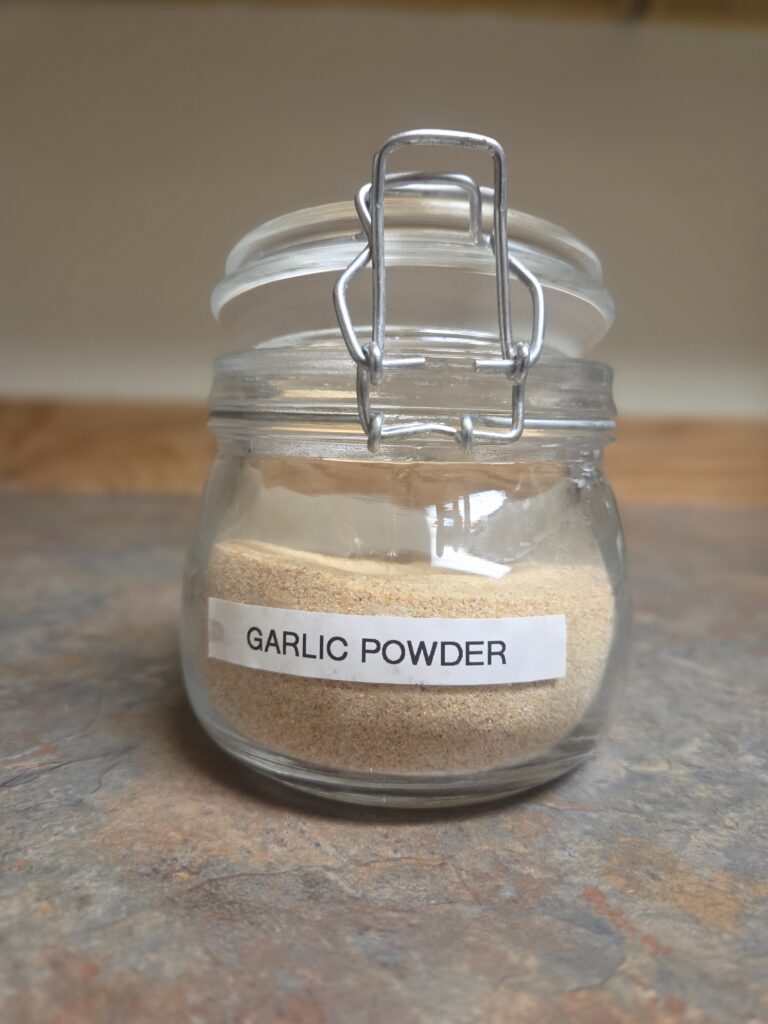
How to make homemade garlic powder in a nutshell: Peel fresh garlic cloves and slice them thinly at about 1/8 inch. Spread in a single layer on dehydrator trays and dry at 125 degrees F for 10 to 12 hours until completely brittle. Let cool fully, then condition in a jar for 5 to 7 days to check for any remaining moisture. Once confirmed dry, grind in a spice grinder until powdered. Store in an airtight jar in a cool, dark place for up to 12 months.
Why Homemade Garlic Powder Is Worth Making
There are a few things that are genuinely worth making from scratch, and garlic powder is at the top of that list. Here is why.
The flavor is not even close. Homemade garlic powder made from fresh garlic has a sharp, punchy, real garlic smell and taste. Store-bought garlic powder has often been sitting in a warehouse and on a shelf for months before you open it. By the time it reaches you, a lot of the volatile compounds that give garlic its flavor have already off-gassed. You are essentially buying old garlic dust.
You control exactly what is in it. Commercial garlic powder often contains silicon dioxide or calcium silicate as anti-caking agents. They are generally considered safe, but they are also completely unnecessary when you store your garlic powder correctly. Homemade is one ingredient: garlic.
It is dramatically cheaper when you buy in bulk. A 3-pound bag of garlic cloves from a warehouse store or farmers market yields a significant amount of garlic powder at a fraction of the cost of buying pre-made jars. The math gets even better if you grow your own.
It is perfect for off-grid and on-the-road cooking. No refrigeration. Lightweight. Shelf-stable for a year or more. It travels well and works in every savory recipe you make.
What You Need
You do not need much.
A dehydrator is the easiest and most reliable way to do this. I use this dehydrator for everyday batches and it handles garlic without any issues. If you do a lot of dehydrating or want to do larger batches, an Excalibur-style tray dehydrator with a horizontal airflow gives more even drying across all trays. If you do not have a dehydrator, the oven method works too and I cover it below.
A spice grinder or coffee grinder is the best tool for grinding dried garlic into powder. I use this spice grinder and it takes less than 30 seconds to get a fine powder. A blender or food processor works but you may get a coarser grind. A mortar and pestle works but takes significantly more effort. You can also use a blender if that is what you have. I have used this blender to blend garlic into powder and it worked great!
Fresh garlic. Any variety works. Softneck garlic is most common in grocery stores and works perfectly. If you grow your own hardneck garlic, it makes excellent powder too and has an even more complex flavor. You can also use pre-peeled garlic cloves from the store to save time, or jarred minced garlic in a pinch (more on that below).
Mason jars with tight-fitting lids for conditioning and storage.
How to Prepare Garlic for Dehydrating
Option 1 – Sliced garlic (best for powder)
Break bulbs into individual cloves. Peel each clove. A silicone garlic peeling tube or two bowls shaken together are both faster than peeling by hand.
Slice each clove thinly at about 1/8 inch. Uniform thickness matters here because uneven slices mean some pieces dry out while others are still moist. A sharp knife works well. A mandoline or a food processor with a slicing blade is faster for large batches.
Option 2 – Minced garlic (faster drying)
Pulse peeled cloves in a food processor until finely minced. Spread on dehydrator trays lined with parchment paper or silicone dehydrator sheets so the small pieces do not fall through.
Minced garlic dries faster than sliced garlic because the pieces are smaller. The tradeoff is that it can be harder to spread evenly and tends to clump on the tray.
Option 3 – Store-bought shortcut
If you want to make a batch quickly without peeling a pound of garlic, jarred minced garlic in water works. Drain off as much liquid as possible, spread on lined dehydrator trays, and dry at 125 degrees F. It is not quite the same flavor as fresh, but it is a legitimate shortcut when you need powder fast.
How to Dehydrate Garlic
Dehydrator method (recommended)
Place prepared garlic in a single layer on dehydrator trays. Pieces should not overlap. If you are using minced garlic or small pieces, line the trays with parchment paper or silicone liners.
Dehydrate at 125 degrees F (52 degrees C) for 10 to 12 hours. Check at the 8-hour mark. Garlic is done when the pieces are completely brittle and snap cleanly when you break them. If they bend at all instead of snapping, they need more time.
A note: garlic smells strong when dehydrating. This is normal. If you are sensitive to strong smells or have limited ventilation, run your dehydrator near an open window or in a garage.
Oven method (no dehydrator needed)
Spread prepared garlic in a single layer on a baking sheet lined with parchment paper.
Set your oven to its lowest temperature, usually 170 degrees F or lower. If your oven does not go below 200 degrees F, prop the door open slightly with a wooden spoon to let moisture escape and keep the temperature from getting too high.
Dry for 2 to 4 hours, checking every 30 minutes and stirring occasionally for even drying. The garlic is done when completely brittle and snapping cleanly.
The oven method takes more attention than the dehydrator but works well.
The Conditioning Step (Do Not Skip This)
This is the step most guides leave out and it is actually important.
After dehydrating, even garlic that feels completely dry can have small pockets of remaining moisture inside. If you grind it immediately and seal it in a jar, that residual moisture can cause clumping, reduced shelf life, or in the worst case, mold.
Conditioning catches this before it becomes a problem.
Let your dehydrated garlic cool completely to room temperature. Transfer to a clean glass mason jar, filling it loosely. Seal the jar and place it somewhere you will see it. Once a day for 5 to 7 days, shake the jar and look at the inside of the glass.
If you see any condensation or moisture droplets forming on the glass, the garlic is not fully dry. Spread it back out on the dehydrator trays and run another 2 to 3 hours, then start the conditioning process again.
If the glass stays clear and dry after 5 to 7 days, your garlic is fully dehydrated and ready to grind.
How to Grind Garlic Into Powder
Once conditioned and confirmed dry, it is time to grind.
Add dehydrated garlic pieces to your spice grinder in small batches. Pulse until you reach your desired texture.
For fine garlic powder: Grind until completely powdered, then sift through a fine mesh strainer. Any larger pieces that do not pass through the strainer can go back in the grinder for another pass.
For garlic granules: Pulse lightly and stop before you reach a powder. Granules are coarser and work well in rubs, marinades, and dishes where you want a little more texture.
For garlic flakes: Do not grind at all. Just store the dehydrated slices as-is. Garlic flakes are great in soups, stews, and slow-cooked dishes where they will rehydrate as the food cooks.
Let the powder cool for a few minutes after grinding before transferring to a storage jar. Grinding creates a small amount of heat and you want the powder to be fully cool before sealing.
Garlic Powder vs Garlic Granules vs Garlic Flakes
All three come from the same dehydrated garlic. The difference is just how finely you grind them.
Garlic powder is the finest grind. It dissolves easily into sauces, marinades, and doughs. Best for recipes where you want garlic flavor without any visible texture, like in homemade taco seasoning or homemade ranch seasoning.
Garlic granules are a medium-coarse grind. They have slightly more texture and a bit more visible presence in a dish. Good in dry rubs and spice blends.
Garlic flakes are the whole dehydrated slices or minced pieces left unground. They take longer to rehydrate in cooking but work well in soups, stews, and slow-cooked dishes. They also last longer than powder because less surface area is exposed to air.
How Much Garlic Powder Equals One Clove?
This comes up constantly in recipes and the conversion is easy to remember.
| Fresh Garlic | Garlic Powder Equivalent |
|---|---|
| 1 small clove | 1/8 teaspoon garlic powder |
| 1 medium clove | 1/4 teaspoon garlic powder |
| 1 large clove | 1/2 teaspoon garlic powder |
| 1 teaspoon minced garlic | 1/4 teaspoon garlic powder |
| 1 tablespoon minced garlic | 3/4 teaspoon garlic powder |
Homemade garlic powder is often more potent than store-bought because it is fresher. Start at the lower end of any conversion and add more to taste.
How to Store Homemade Garlic Powder
Proper storage is the difference between garlic powder that lasts 6 months and garlic powder that lasts 2 years.
Everyday storage (6 to 12 months): Transfer cooled powder to a clean, dry glass mason jar. Seal tightly and store in a cool, dark pantry away from heat sources like the stove. A vacuum-sealed mason jar extends shelf life even further by removing the oxygen that causes powder to go stale.
Travel and on-the-road storage: Small glass jars with tight lids work well in a vehicle kitchen. Keep them in a cabinet away from direct sunlight and heat. If you are in a hot climate or your rig gets warm inside, consider keeping your spices in an insulated bag or cooler during the hottest part of the day.
Long-term bulk storage: For large batches, seal in mylar bags with oxygen absorbers for storage of 2 to 3 years or more. This is especially useful if you make garlic powder from a large garden harvest and want to preserve the whole batch at once.
Signs your garlic powder has gone bad: No smell when you open the jar is the clearest sign. Fresh garlic powder smells sharp and garlicky. If you open the jar and smell nothing, the flavor compounds have off-gassed and it is time to make a new batch. Visible clumping from moisture is another sign. A little clumping is normal, but heavy clumping or any off smells mean toss it.
What to Make With Homemade Garlic Powder
Once you have a jar ready, here is where it earns its place:
Seasoning blends from scratch. Garlic powder is the backbone of almost every homemade spice blend. It goes into taco seasoning, Italian seasoning, ranch seasoning, fajita seasoning, and seasoned salt. When you make your own garlic powder, all of those blends get significantly better.
Everyday cooking. Use anywhere you would use fresh garlic when you do not want to peel and chop. Scrambled eggs, roasted vegetables, homemade salad dressings, soups, and marinades all work great.
Garlic salt. Mix one part homemade garlic powder with three parts good quality salt for a simple garlic salt with no fillers or additives, or see my full garlic salt recipe for exact ratios and storage tips.
Gift giving. A small mason jar of homemade garlic powder with a handwritten label makes a genuinely good gift for anyone who cooks.
If you’re building a pantry that can go anywhere you go, I put together a free guide on exactly that. It’s called the From-Scratch Pantry Starter Guide, grab it below.
Frequently Asked Questions
How long does homemade garlic powder last? Stored in an airtight container in a cool, dark place, homemade garlic powder lasts 6 to 12 months at full potency. Vacuum-sealed jars can extend this to 18 months or more. Sealed in mylar bags with oxygen absorbers, 2 to 3 years. The flavor starts to fade before it becomes unsafe, so use your nose. No smell means no flavor.
Can I make garlic powder without a dehydrator? Yes. Use your oven on its lowest setting with the door propped open slightly for ventilation. It takes 2 to 4 hours and requires more attention than a dehydrator, but works well. The main risk is going too hot, which can cook the garlic instead of drying it and changes the flavor.
Why is my garlic powder clumping? Clumping happens when there is residual moisture in the powder. Either the garlic was not fully dehydrated before grinding, or moisture got into the jar after storing. If it is clumping significantly, spread the powder back on a dehydrator tray or baking sheet for an hour to dry it out further, then re-jar in a fully dry container. A small food-grade silica packet in the jar helps prevent future clumping.
Can I use pre-peeled garlic from the store? Yes. Pre-peeled cloves from the store work just fine for dehydrating. The flavor may be slightly less intense than garlic you peel yourself from fresh bulbs, but it is a legitimate time-saving shortcut. Jarred minced garlic also works in a pinch.
Does dehydrating garlic destroy its nutrients? Some heat-sensitive compounds do break down with dehydrating, but garlic powder still retains significant amounts of allicin, the primary beneficial compound in garlic. It is not identical to raw fresh garlic nutritionally, but it is far closer than many people expect.
How much fresh garlic does it take to make garlic powder? This varies by garlic variety and moisture content, but a rough estimate is that 1 pound of fresh garlic cloves yields approximately 2 to 3 ounces of garlic powder. If you are making a large batch, buy significantly more fresh garlic than you think you need.
Can I dehydrate garlic that has already started to sprout? Yes. Sprouted garlic is safe to eat and dehydrate. The sprout itself can have a slightly more bitter flavor, so many people remove the green sprout from the center of the clove before dehydrating. The rest of the clove is perfectly usable.
CONCLUSION
There is a version of cooking where you buy every ingredient pre-processed and pre-packaged and you never think much about where it comes from or how it was made.
And then there is the version where you buy a bag of garlic, run it through a dehydrator, and grind it into something that smells so good you stand over the spice grinder just breathing it in.
That second version is more work. But it is also more satisfying, cheaper, and honestly just better food.
Once you make your own garlic powder, the little jar from the store starts to feel like a step backwards. And once you have made it once, you will realize there is a whole pantry full of things you could be making the same way.
That is the skill worth building. Not a single recipe, but a way of looking at your kitchen and seeing what you can make instead of buy.
With love and adventure,
Mindy
Have you made your own garlic powder before? Drop a comment and tell me what you use it in most. I am always looking for new ideas.
📌Pin for Later


Homemade Dehydrated Garlic Powder
Homemade garlic powder made from fresh dehydrated garlic cloves. Stronger flavor than store-bought, one ingredient, and shelf-stable for up to a year.
Ingredients
- Garlic Cloves (as many as you want)
- Minced garlic works as well
Instructions
- Peel the Garlic - Break apart the garlic bulbs into cloves. Peel each clove.
- Slice Thinly - Use a sharp knife to slice cloves evenly, about 1/8 inch thick. Uniform slices ensure even drying. (You can also pulse them in a food processor to make minced garlic. This makes them dry quicker)
- Dehydrate the Garlic - Place garlic slices (or minced garlic) in a single layer on dehydrator trays. Dehydrate at 125°F (52°C) for 10–12 hours, or until completely dry and brittle. If using an oven, set the lowest temperature, place slices on a baking sheet, and prop the oven door open slightly to allow moisture to escape.
- Cool Completely - Let garlic cool before grinding to avoid moisture build-up.
- Grind into Powder - Use a spice grinder, blender, or mortar and pestle to grind dried garlic into a fine powder. For garlic granules, pulse lightly and stop before reaching powder stage.
- Store Properly - Transfer garlic powder to an airtight glass jar. Store in a cool, dark place. Properly stored, it lasts 12 months or more.
Notes
- Condition dehydrated garlic in a sealed jar for 5 to 7 days before grinding. If condensation appears on the glass, return to the dehydrator for 2 more hours.
- Store in a vacuum-sealed mason jar for up to 12 months, or in mylar bags with oxygen absorbers for 2 to 3 years.
- 1 pound of fresh garlic yields approximately 2 to 3 ounces of garlic powder.