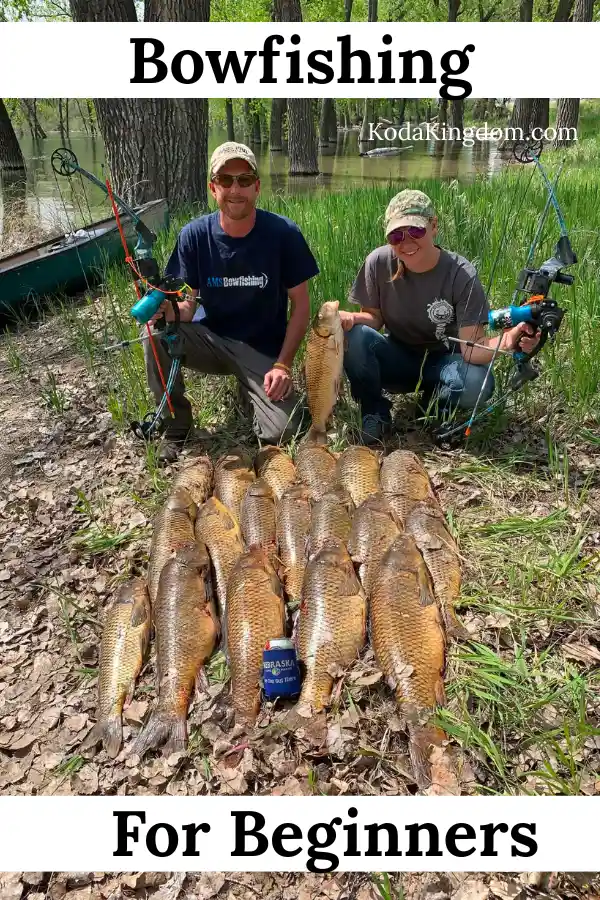

I had never heard of bowfishing until the summer of 2018.
I knew spearfishing was a thing. It sounded cool in theory, but it required being underwater, which meant good weather, a wetsuit, or both. I also didn’t know a single person who actually did it. So it stayed on the list of things I thought about and never pursued.
Bowfishing was different. I had met someone who knew exactly what he was doing, and he was willing to teach me. That person was Curtis. And what started as a casual afternoon at a campground in Nebraska with a compound bow and a target turned into my absolute favorite sport. It still is, years later.
If you have been curious about bowfishing but have no idea where to start, this is the post I wish existed when I first picked up a bow. I am not going to overload you with technical gear specs. I am going to tell you what it actually feels like to learn, what nobody warned me about, and what you really need to get started.
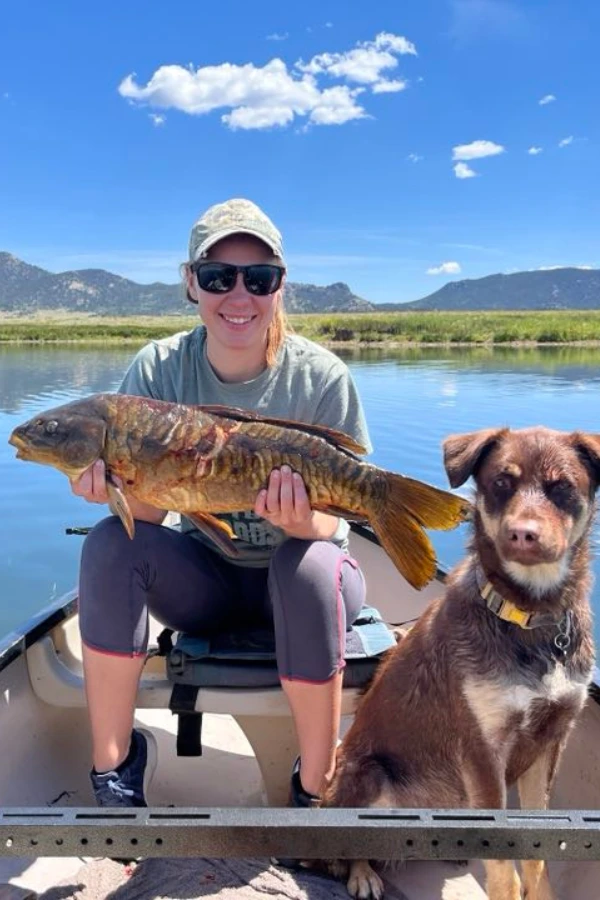
Bowfishing for beginners in a nutshell: Bowfishing is fishing with a bow and arrow. You stand over shallow water, spot fish near the surface, and shoot. The arrow is attached to a reel on the bow so you can retrieve it (and hopefully your fish) after every shot. It is active, addictive, and one of the most fun things you can do outside.
How I Got Into Bowfishing (The Real Story)
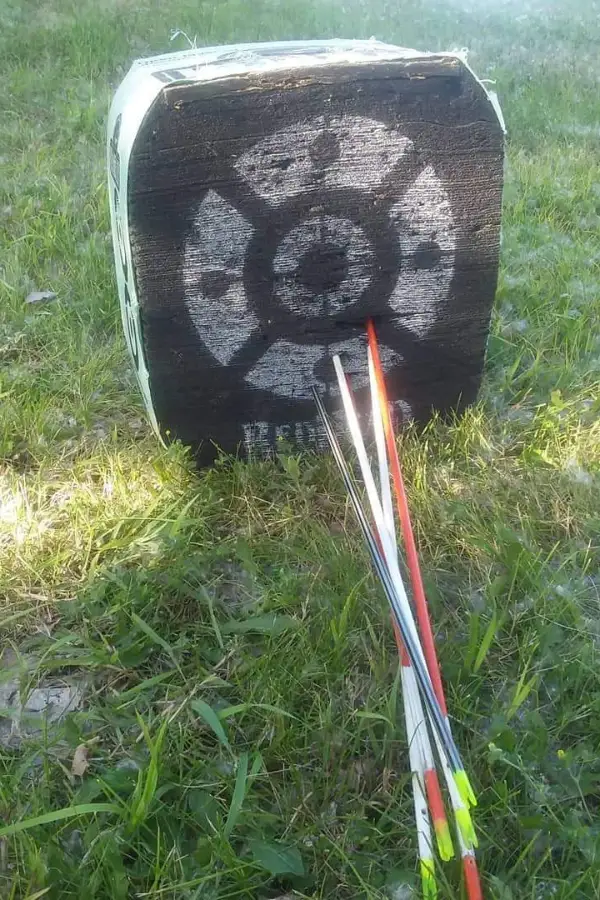
It didn’t start out as some elaborate trip or a big training session. It started on a beautiful sunny day at a campground in Nebraska (the same summer I was working at a state park, which is how Curtis and I met in the first place). Curtis brought out his extra compound bow, dialed the draw weight down to something I could actually pull back, and set up a target. That was it. That was how it began.
Draw weight is basically how much strength it takes to pull the bow back. Curtis can pull back a lot more than I can because he is bigger and stronger. The bow adjusts for that. You do not need to be incredibly strong to bowfish. You just need to be able to pull back your own bow comfortably, over and over again, for hours at a time. Start lower than you think you need to. You can always work up.
My first shots at that target were embarrassing. Curtis would shoot and the arrow would land exactly where he aimed it. I would shoot and then immediately go on a hunt to find mine somewhere in the grass behind the target. That is not an exaggeration.
But here is the thing about me. I am stubborn when I am bad at something. So I stood at that target and practiced for hours.
At some point Curtis noticed I was rubbing my forearm. He asked if the bowstring had been catching me on the release. I said yes. He showed me what I was doing wrong.
When you hold a bow, you can’t lock your arm straight out. You need a slight bend in your elbow, rotated out of the way so the string has room to pass. Otherwise it snaps forward and catches your forearm on the way through. I had been doing it wrong all afternoon. By the next morning I had a bruise on my arm about the size of a lemon.
I rarely make that mistake anymore, but it does happen occasionally, even after all these years. Consider yourself warned.
Bowfishing From a Canoe: My First Three Days.
Over the next couple of weeks I kept practicing on land. When I was consistently hitting the target, Curtis asked if I wanted to try for real fish.
Nervously and excitedly, I said yes.
We took the canoe out on a nearby lake. Our first attempt was during the day because it felt like the safest option. I had never bowfished before, I had never stood up in a canoe before, and Curtis had never taken someone completely inexperienced out on his canoe before. Daytime felt like the right call.
To see fish in the water you have to be standing above it, looking down into it. The angle cuts through the glare in a way that sitting cannot. Curtis also handed me his polarized sunglasses because I didn’t have any. I know they looked absolutely ridiculous on me, but I didn’t care.
Curtis paddled me around that lake for three days before I hit a fish.
Three full days. He never got frustrated. Never got annoyed. He just paddled, quietly gave me tips and pointers, and kept going. I am not sure I deserved that kind of patience but I am really glad he had it. One of the many reasons I ended up falling in love with him.
The reason it took me so long was the refraction. When you look into water, the fish is not actually where it looks like it is. Light bends when it passes through water, which means your eyes are lying to you. What you see and where you need to aim are two completely different things. The general rule is to aim lower than your instincts tell you, usually aiming for the belly of the fish or about six inches below where it appears to be. But knowing that and actually doing it are very different things when you are standing in a rocking canoe trying to time your shot.
On day three I nailed my first carp. I cannot describe the feeling. I was immediately and completely hooked.
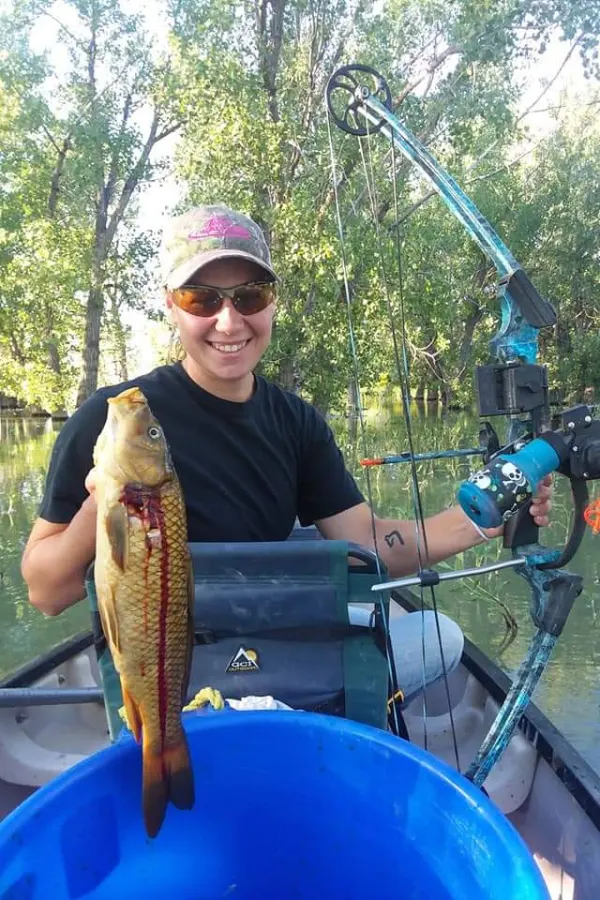
Day Bowfishing vs. Night Bowfishing
Once I got my first fish we were out on the water every chance we got. We usually went after work since we rarely had the same days off. We would go out during the day and then when the sun started setting we would head back to camp, gear up, and go back out for the night.
Headlamps, flashlights, jackets, bug nets. All of it.
Night bowfishing is surprisingly easier than day bowfishing for seeing the fish. When you shine a light down into the water at night the visibility is actually really clear. Fish are also more active near the surface at night in a lot of conditions, which means more shots.
Most nights we would get back to the camper just in time for a short nap and then go to work again. We didn’t care, we were having a blast.
Looking back, the one thing I wish we had back then was our Harvest Right freeze dryer. We were so busy and so tired that meals were whatever was fast and required no thought. Having shelf-stable, ready-to-eat food that actually tasted good would have been a game changer on those nights. Now when we head out for long stretches on the water, we do not have to think about it. If you are someone who spends a lot of time outdoors and wants real food without the cooler and the planning, this post on ready-to-eat meals without a cooler is worth reading.
Those long nights on the water are exactly why I built a pantry that goes anywhere with us. The simple system behind it is in my free From-Scratch Pantry Starter Guide, and you can grab it right here.
How to Aim When Bowfishing
Aim lower than you think you need to. Seriously! Aim low, then aim even lower.
The refraction in the water is the thing that trips up every single beginner, myself included. Your brain wants to aim at the fish you see. The fish you see is not where the fish actually is. It is higher than where it actually is because of the way light bends through water.
The rule of thumb is to aim about six inches below the fish, or at the belly of a larger fish. The deeper the fish and the flatter your angle to the water, the lower you need to aim. Standing up and shooting straighter down makes the math a lot easier. But in practice you just learn to trust your instincts after enough shots. It clicks at some point and then it feels natural.
Do not get frustrated when you miss. You are going to miss a lot at first. That is just part of learning. Curtis paddled me around for three days before I got one in the canoe. He missed plenty of shots too, just fewer than I did. I still miss to this day. You are never going to hit 100% of the shot fired.
What You Actually Need to Get Started
You do not need expensive gear to start bowfishing. Curtis had all of our equipment when we met and got me set up before I ever got my own bow. Here is the basics of what you need.
A bow with a bowfishing reel
Any compound bow or lever bow that fits your draw weight and draw length will work. The reel attaches directly to the bow and holds the line that connects to your arrow. We started out with compound bows and bottle reels, which are exactly what they sound like, a bottle that holds the line. They work, but they are older technology and they slow down the trajectory of the arrow more than the newer options. Curtis eventually upgraded us both to lever bows and Muzzy reels, which he says make a noticeable difference in how the arrow travels. If you are buying new, skip the bottle reel and go straight to a modern option.
Bowfishing arrows
Bowfishing arrows are heavier and more durable than regular arrows. They are designed to take a beating, go through water, and be retrieved over and over again. Do not use regular arrows for this.
Polarized sunglasses
For daytime bowfishing these are not optional. Polarized lenses cut through the glare on the water and let you actually see the fish. Without them you are basically guessing. This is the style I wear. The wraparound fit keeps the sun out from the sides too, which makes a real difference when you are scanning the water for fish.
Lights for night bowfishing
Headlamps and handheld flashlights are what we used starting out. There are dedicated bowfishing lights that mount to a boat if you eventually get more serious about it, but for canoe or bank fishing a couple of good lights get the job done.
An arm guard.
Cheap insurance against the lemon-sized bruise.
A life jacket.
If you’re standing up in a canoe or a boat, wear one. We learned to stand and shoot in a canoe, and I’m not going to pretend nobody ever gets wet.
That is genuinely all you need to start. Do not overthink the gear and get on the water.
A quick note on the links above: they are not the exact gear we personally own, but they will give you a solid idea of what each piece of equipment looks like and what you are shopping for when you are ready.
Bowfishing Safety Basics
Before every shot, check that your line is free and not wrapped around your bow or reel. A tangled line can snap the arrow back toward you. Know what’s beyond your target, never shoot toward another boat or person, and keep the bow pointed down at the water between shots. And if you’re standing in a canoe or a small boat, wear a life jacket.
Why Bowfishing is Actually Good for the Environment
This is something I want to address because people who don’t know bowfishing sometimes wonder about it.
The main target for most bowfishers, including us, is carp. Carp are considered an invasive species in most of the United States. They compete with native fish for food and resources, destroy spawning areas and nesting beds, and eat the eggs of game fish. Too many carp in a body of water and the game fish population suffers for it. In some waterways, they’ve made it much harder for native fish to survive.
By bowfishing carp, we are actually helping reduce a population that fish and game departments actively want controlled. It is one of those rare situations where something that is genuinely fun is also genuinely helpful to the ecosystem.
Every state has its own regulations on what species you can target, what seasons apply, and what equipment is required. Some states have open seasons on certain game fish as well, but the rules vary a lot. Always check your local regulations before you go. A fishing license is required in most states.
The Nebraska Record Nobody Officially Knows About
I have to tell this part of the story.
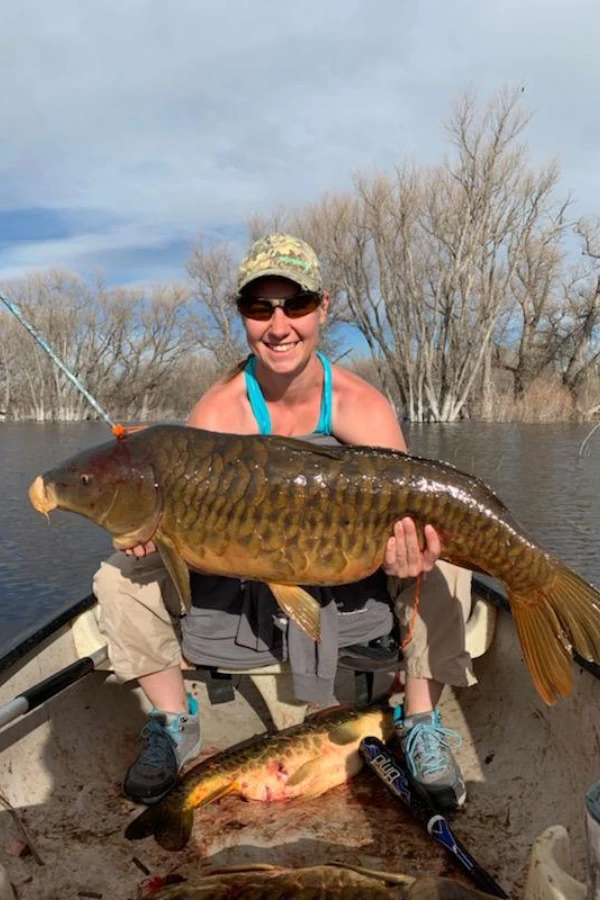
After quite a few bowfishing trips I started giving Curtis a real run for his money. We would compete on who got more fish into the canoe and who landed the biggest one. It got competitive fast but in a fun way.
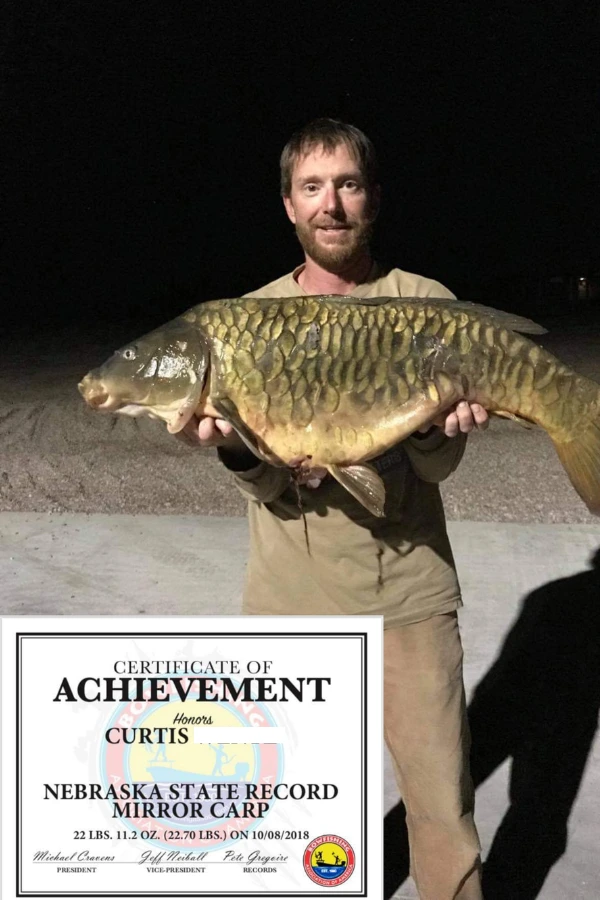
Curtis shot the Nebraska state record for largest carp taken with a bow. He was proud of it. A few weeks later I beat that record.
However, I never sent my information in to get it documented.
Curtis still holds the record on paper. He still tells that story to anyone who will listen. But he always includes the part about how I beat it and never turned it in.
I still think about doing it one of these days. Maybe after he reads this post. Who knows!
Is Bowfishing Hard to Learn?
Yes and no.
The mechanics of shooting a bow are not complicated. With a little practice on a land target, most people can figure out the basics pretty quickly. The part that takes time is the water. The refraction messes with your aim in a way that feels impossible to correct at first and then suddenly clicks into place.
The best thing I can tell you is to practice on a target on land until you are consistently accurate. Then get on the water with someone who knows what they are doing if at all possible. Having Curtis there to coach me, adjust my bow, and paddle me around patiently made a massive difference.
And give yourself more than one trip before you decide whether you like it. I did not get my first fish until day three. If I had quit after day one I never would have found my favorite sport.
Some seasons we bowfish more than others. Life gets busy and sometimes we are just not in a place where it is practical. But every single time we get back out on the water with a bow in my hands I remember exactly why I love it.
There is nothing like standing in a canoe at dusk, watching the light drop off the water, and knowing a shot is coming. Nothing like it.
If you have been thinking about trying it, stop thinking and start looking for a body of water near you. Find someone who will show you the basics if you can. And if you end up with a lemon-sized bruise on your forearm the first time, just know that you are in good company.
With love and adventure,
Mindy
Have you ever tried bowfishing or have you been curious about it? Drop a comment and tell me where you are. One of Curtis’s dreams is to become a bowfishing guide someday, and honestly this post might just be the start of that. So if you are out there and want a few pointers, let us know. We might just be in your area, and we love teaching this sport.
📌Pin For Later