

I have honestly never been able to find a real comparison when it comes to store-bought vs homemade dry mixes.
I have read countless articles claiming that making your own is cheaper, but none of them actually show the math. They throw out round numbers and expect you to believe them without proof. That never sat right with me.
So instead of guessing, I decided to do the math myself, step by step, and share the real numbers with you so you can decide what makes sense for your pantry, budget, and values.
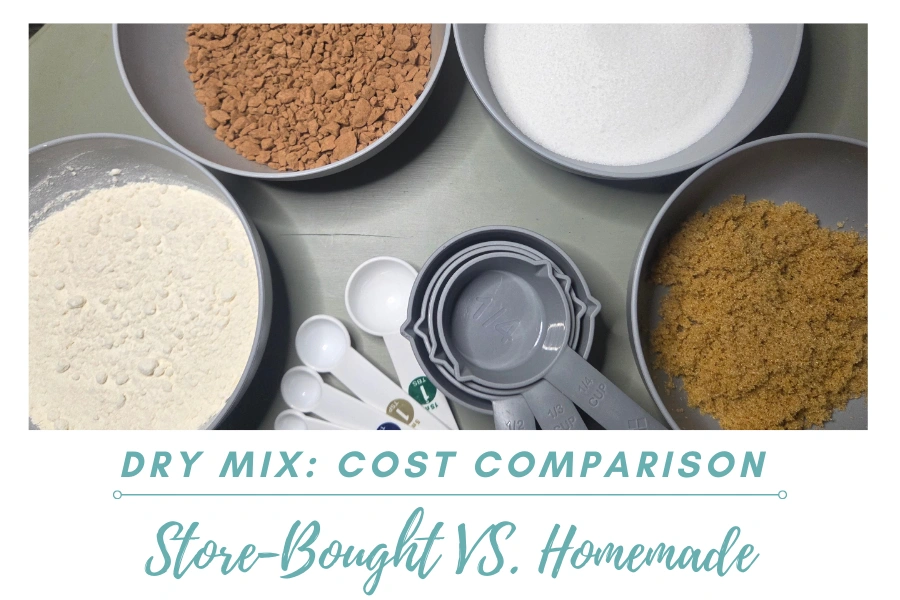
Why I Started Making My Own Dry Mixes (Before Cost Even Mattered)
When I first started making homemade dry mixes, cost was not my motivation at all.
What pushed me over the edge was reading ingredient labels.
Have you ever stood in a grocery aisle, turned a package over, and realized you could not even pronounce half the ingredients? I remember thinking: if I cannot say it, should I really be eating it?
That question alone was enough to make me start experimenting in my own kitchen. Now that I have been making dry mixes for a while, I wanted to answer the question honestly. Am I actually saving money, or am I just paying for peace of mind?
Spoiler: sometimes it is cheaper, sometimes it is not.
How This Comparison Works (So the Math Is Fair)
To keep things realistic and accessible, I used Walmart Great Value pricing since it is widely available and budget-friendly. I used regular prices, not sales. I broke everything down into cost per cup or tablespoon using the same units my recipes use so the math stays practical.
Prices fluctuate, but the method stays the same and that is what matters.
The short answer before we dive in: homemade dry mixes are almost always cheaper per use once you already have the base ingredients on hand. The upfront cost of buying individual spices and staples can look more expensive at first, but the cost per batch drops significantly after that first purchase. For mixes you use frequently like taco seasoning or ranch, homemade wins by a wide margin. For mixes with specialty ingredients like cream of tartar in baking powder, the savings are smaller or nonexistent.
The real advantage of homemade is not always cost. It is control over ingredients, less packaging waste, and a pantry that makes more meals from fewer items.
Example 1: Brown Sugar (The Simplest Comparison)
Store-Bought: Great Value Brown Sugar
- Price: $2.22 for 32 oz
- 32 oz = 4 cups
- Cost per cup: $0.56
Ingredients: sugar, molasses. No red flags here.
Homemade Brown Sugar
My homemade brown sugar recipe uses two ingredients: granulated sugar and unsulphured molasses.
Granulated sugar: $3.46 for 4 lbs, approximately 9 cups = $0.38 per cup Molasses: $3.94 for 12 fl oz, approximately 24 tablespoons = $0.16 per tablespoon
Recipe: 1 cup sugar + 1 tablespoon molasses
Total cost: $0.38 + $0.16 = $0.54 per cup
Verdict: Brown Sugar
| Store-Bought Vs. Homemade | Cost Per Cup |
|---|---|
| Great Value store-bought | $0.56 |
| Homemade | $0.54 |
You save about 2 cents per cup. This one is basically a wash. If you already use molasses for other things, make it at home. If not, buying store-bought brown sugar is perfectly reasonable.
Example #2: Baking Powder (Where Things Get Interesting)
Store-Bought: Great Value Baking Powder
- Price: $1.98 for 8.1 oz
- Approximately 16.2 tablespoons
- Cost per tablespoon: $0.12
Ingredients: corn starch, sodium bicarbonate, sodium aluminum sulfate, monocalcium phosphate.
That third ingredient is what made me pause.
Homemade Baking Powder
My homemade baking powder recipe uses two ingredients: cream of tartar and baking soda.
Cream of tartar: $2.54 for 2.75 oz, approximately 5.5 tablespoons = $0.46 per tablespoon Baking soda: $0.92 for 1 lb, approximately 32 tablespoons = $0.03 per tablespoon
Recipe: 2 tablespoons cream of tartar + 1 tablespoon baking soda = 3 tablespoons total
Cost: ($0.46 x 2) + $0.03 = $0.95 for 3 tablespoons = $0.32 per tablespoon
Verdict: Baking Powder
| Store-Bought Vs. Homemade | Cost Per Tablespoon |
|---|---|
| Great Value store-bought | $0.12 |
| Homemade | $0.32 |
Homemade is not cheaper here. But here is the key difference: homemade baking powder contains two ingredients you recognize with no aluminum compounds or fillers. Whether that trade-off is worth it to you is a personal call.
Example #3: Taco Seasoning (Where Homemade Wins Big)
Store-Bought Taco Seasoning
- Price: $0.47 per 1 oz packet
- 1 oz packet = about 2 tablespoons
- Cost per tablespoon: $0.24
Ingredients: chili pepper, salt, spices, maltodextrin, onion powder, garlic powder, silicon dioxide.
Homemade Taco Seasoning
Using my homemade taco seasoning recipe, a typical batch uses chili powder, cumin, garlic powder, onion powder, paprika, and salt. All staple spices you likely already have in your pantry.
A full batch of homemade taco seasoning (about 6 tablespoons, equivalent to 3 store packets) costs roughly $0.80 to $1.00 total in ingredients, or about $0.13 to $0.17 per tablespoon.
Verdict: Taco Seasoning
| Store-Bought vs. Homemade | Cost Per Tablespoon |
|---|---|
| Great Value store-bought | $0.24 |
| Homemade | $0.13 to $0.17 |
You save roughly 30 to 45 percent per batch. A family that makes tacos twice a week saves $25 to $35 per year on this one mix alone. And your homemade version has zero maltodextrin or silicon dioxide.
Example #4: Ranch Seasoning
Store-Bought: Great Value Ranch Dressing Mix
- Price: $0.68 per 1 oz packet
- Makes 2 cups of dressing or dip
- Cost per use: $0.68
Ingredients: maltodextrin, salt, monosodium glutamate, buttermilk solids (from milk), whey (from milk), lactic acid, food starch-modified, dried garlic, dried onions, citric acid, dried parsley, dry whole milk (from milk), acid casein (from milk), guar gum, calcium stearate, hydroxypropyl methylcellulose. Contains milk.
That is 18 ingredients. Eighteen.
Homemade Ranch Seasoning
My homemade ranch seasoning uses dried dill, garlic powder, onion powder, dried parsley, salt, and pepper. Six ingredients, all recognizable.
A full jar equivalent to 8 to 10 store packets costs about $1.50 to $2.00 in spices. Cost per use: $0.15 to $0.25.
Verdict: Ranch Seasoning
| Store-Bought Vs. Homemade | Cost Per Use |
|---|---|
| Great Value store-bought | $0.68 |
| Homemade | $0.15 to $0.25 |
You save 60 to 78 percent per batch. No MSG, no guar gum, no hydroxypropyl methylcellulose. Just actual herbs and spices.
Example #5: Country Gravy Mix
Store-Bought: Great Value Country Gravy Mix
- Price: $1.42 for 2.5 oz packet
- Makes about 2 cups of gravy
- Cost per batch: $1.42
Homemade Country Gravy Mix
My homemade country gravy dry mix uses flour, powdered milk, salt, and pepper. Pantry staples that cost a fraction of the packet.
Cost per batch: roughly $0.25 to $0.40
Verdict: Country Gravy Mix
| Store-Bought Vs. Homemade | Cost Per Batch |
|---|---|
| Great Value store-bought | $1.42 |
| Homemade | $0.25 to $0.40 |
You save 70 to 82 percent per batch. This is one of the biggest savings in the whole list. And the homemade version uses ingredients you already have on hand for a dozen other recipes.
Example #6: Cream of Mushroom Soup
Store-Bought: Great Value Cream of Mushroom Soup
- Price: $0.74 per 10.5 oz can
- One can replaces one batch in most casserole recipes
- Cost per use: $0.74
Homemade Cream of Anything Soup Mix
My homemade cream of anything soup uses flour, powdered milk, butter or oil, salt, and your choice of base flavor. The dry mix version stores beautifully in a jar and is ready to use like any can.
Cost per batch: about $0.30 to $0.45
Verdict: Cream of Mushroom Soup
| Store-Bought Vs. Homemade | Cost Per Batch |
|---|---|
| Great Value store-bought | $0.74 |
| Homemade | $0.30 to $0.45 |
You save 40 to 60 percent per batch. The bigger win here is knowing exactly what is going into your casseroles and soups. Canned cream soups are some of the most additive-heavy products in the grocery store.
Example #7: Pancake Mix
Store-Bought: Great Value Complete Pancake Mix
- Price: $2.05 for 32 oz
- 32 oz makes approximately 32 to 40 pancakes
- Cost per pancake: about $0.05 to $0.06
Homemade Pancake Mix
Flour, baking powder, salt, and sugar. The dry ingredients for a batch of 12 pancakes cost roughly $0.20 to $0.30 total.
Cost per pancake: about $0.02 to $0.03
Verdict: Pancake Mix
| Store-Bought Vs. Homemade | Cost Per Pancake |
|---|---|
| Great Value store-bought | $0.05 to $0.06 |
| Homemade | $0.02 to $0.03 |
You save about 50 to 60 percent. And once you have the dry mix made and stored in a jar, it takes the same amount of time as opening a box.
FULL SUMMARY TABLE
| Mix | Great Value Price | Homemade Cost | Savings |
|---|---|---|---|
| Brown Sugar (per cup) | $0.56 | $0.54 | Basically even |
| Baking Powder (per tbsp) | $0.12 | $0.32 | Store wins |
| Taco Seasoning (per tbsp) | $0.24 | $0.13 to $0.17 | Homemade saves 30-45% |
| Ranch Seasoning (per use) | $0.68 | $0.15 to $0.25 | Homemade saves 60-78% |
| Country Gravy Mix (per batch) | $1.42 | $0.25 to $0.40 | Homemade saves 70-82% |
| Cream of Mushroom (per batch) | $0.74 | $0.30 to $0.45 | Homemade saves 40-60% |
| Pancake Mix (per pancake) | $0.05 to $0.06 | $0.02 to $0.03 | Homemade saves 50-60% |
Bottom line: Homemade wins on almost everything except baking powder, where the cost of cream of tartar makes store-bought cheaper per tablespoon. But even there, homemade baking powder has two recognizable ingredients versus four, including aluminum compounds.
Is Homemade Actually Cheaper?
Here is the honest answer: not always. But that does not mean it is a bad choice.
If you are already buying the base ingredients, then purchasing pre-made versions of the same thing is where money leaks out of your pantry budget.
If you never plan to use molasses again, buying brown sugar makes sense. But if you already have sugar, flour, salt, baking soda, and basic spices, then buying pre-mixed packets on top of that is where you start overspending. You are not paying for ingredients. You are paying for convenience.
Why One Bag of Flour Beats Eight Premade Mixes
One of the biggest mindset shifts I had to make when building a self-sufficient pantry was realizing that raw ingredients give you options, while premade mixes lock you into one purpose.
A single 5-lb bag of Great Value all-purpose flour (about $2.38 at Walmart) does not just make one thing. It becomes the base for dozens of meals, mixes, and pantry staples without needing to buy separate boxes for each one.
One 5-lb bag of flour (10 cups, $2.38) can make:
- Pancakes – flour + baking powder + sugar + salt
- Biscuits – flour + fat + baking powder
- Bread loaves – flour + yeast + salt + water
- Pizza dough – flour + yeast + oil
- Flour tortillas – flour + fat + water
- Cookies – flour + sugar + fat
- Muffins – flour + baking powder + sugar
- Gravy and roux – flour + fat
- Homemade baking mix – flour + baking powder + salt
- Thickener for soups and sauces – flour + liquid
To make that same variety using premade products, you would need pancake mix ($2.05), biscuit mix ($2.18), pizza dough mix ($1.98), tortilla mix ($3.92), cookie mix ($1.72), muffin mix ($2.18), gravy packets ($1.42 each), and baking mix ($2.18). That adds up to $17 or more, and you still do not have bread.
One bag of flour versus seventeen dollars of single-use mixes. The math is hard to argue with.
The Real Pantry Advantage Nobody Talks About
When you buy premade mixes, you are paying multiple times for flour, packaging, processing, and shelf space. When you buy flour once, you stretch it across meals, adapt based on what you already have, and stop panic-buying just-in-case items.
This is exactly how you build a pantry slowly, intentionally, and affordably. Not by buying everything at once, but by buying fewer, more versatile things and learning what they can do.
Frequently Asked Questions
Is homemade always healthier? Not automatically, but you control the ingredients and that matters when you are reading labels like the 18-ingredient ranch packet above.
Does homemade dry mix last as long as store-bought? Yes, when stored properly in airtight containers. I use these dry mix containers and store everything in a cool, dark pantry.
Free Resource for You
If you want to start tracking what you actually use instead of guessing, grab my free From Scratch Pantry System. It helps you stop overbuying and build a pantry that matches your real life.
Grab the Free From Scratch Pantry System here
Final Thoughts
Making homemade dry mixes is not about proving you save money every single time. It is about reducing grocery trips, avoiding unnecessary ingredients, using what you already have, and building a pantry that works for you.
Sometimes it saves money, sometimes it saves stress, sometimes it saves your health and sometimes it does all three.
With love and adventure,
Mindy
Which mix surprised you most? Drop a comment and tell me which one you are going to try first.
Related Reading
- Building a pantry When Money Is Tight
- Dehydrating vs Freeze Drying. Which is Better?
- How much food to stock for a 6 Month Pantry
📌Pin For Later
I no longer make brown sugar. I have a spread sheet that I have the amount of molasses to add to granular sucralise &/or sugar ranging from 1 TBSP packed brown sugar up to 1 cup packed brown sugar. Knowing how to make baking powder is good to know when the baking powder dies. For mixes that call for baking powder, the shelf life shifts to years if you omit bsking powder & note down how much baking powder to add per cup of dry mix. Baking powder has a short shelf life.