
When you live and cook in a small space, everything you own has to earn its place.
I have been cooking off-grid and in small spaces for years. School bus kitchens, seasonal housing inside national parks, campsites, and everything in between. I do not have room for gadgets that only do one thing. I do not have patience for tools that break after a season. And I do not have money to waste on things that look good but do not hold up.
This list is the exact gear I reach for every week. Cast iron that goes on any heat source. Storage containers that work whether I am stationary or moving. Dehydrating tools that have run hundreds of batches without issues. Camping essentials that have been to more national parks than most people visit in a lifetime.
No sponsorships. No trendy gadgets. Just the things that actually work in a real off-grid kitchen.
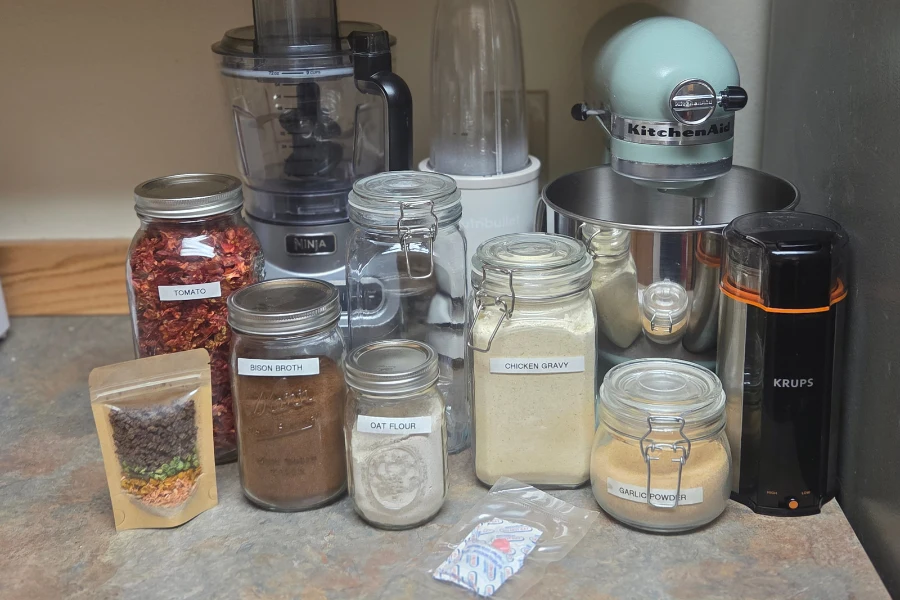
Off-grid kitchen essentials in a nutshell: Cast iron for cooking on any heat source, glass jars or mylar bags for storage depending on whether you’re stationary or moving, a dehydrator and freeze dryer for food preservation, and lightweight camp gear that heats water fast. Every tool on this list does more than one job and is durable enough to travel.
Part 1: Daily Off-Grid Kitchen Essentials
Cast Iron Cookware
Cast iron is the backbone of my entire kitchen and has been for years. It works on all cooking surfaces (propane, wood fire, camp stove, oven, and grill), it lasts decades with basic care, it is non-toxic and gets better the more you use it. When you are cooking in a space where you cannot have twenty different pans, cast iron covers almost everything.
The two pieces I use constantly:
The Lodge 10-12 inch cast iron skillet handles everything from scrambled eggs in the morning to seared meat at night. It goes straight from the camp stove to the table. One pan, almost every meal.
The Lodge Dutch Oven is what I use for soups, stews, bread, and anything that needs to simmer for a while. It holds heat evenly and works just as well over a fire as it does on a stove. If I could only keep two pieces of cookware, these would be them.
Storage Containers
Storage is one of the most important parts of an off-grid kitchen and one of the most overlooked. The wrong containers mean spilled dry mixes, stale food, and wasted money. The right containers mean a pantry that stays organized whether you are parked for the winter or moving every few days.
I use different containers depending on whether I am stationary or traveling.
When stationary, I use glass. Glass does not absorb flavors or smells, it does not leach anything into the food, and you can see exactly what is inside without opening it. I keep mason jars in three sizes for different purposes:
- Small Mason Jars for individual spice blends, small dry mixes, and herbs
- Medium Mason Jars for larger dry mixes like ranch seasoning and taco seasoning
- Large Mason Jars for bulk grains, oats, flour, and sugar
For glass containers with lids that I use for prepped food and leftovers:
When traveling, I switch to mylar bags for anything that needs to survive movement without breaking. Mylar blocks light and moisture better than any other lightweight option and does not shatter if something shifts in the rig:
- Small Mylar Bags for individual meal portions and spice mixes
- Medium Mylar Bags for larger dry goods
- Large Mylar Bags for bulk long-term storage with oxygen absorbers
If you’re building or upgrading your off-grid pantry, grab my free From-Scratch Pantry Starter Guide, it includes a printable checklist and the core staples to stock first.
Part 2: Food Preservation Tools
Freeze Dryer (The Tool That Changed Everything)
If there is one piece of equipment that changed how I cook and stock food more than anything else, it is the Harvest Right freeze dryer.
I used to rely almost entirely on my dehydrator for food preservation. It did the job and I still use it regularly. But once I got the freeze dryer, everything shifted. Freeze dried food has a 25-year shelf life when sealed in mylar bags with oxygen absorbers. The texture, flavor, and nutrition are preserved better than any other method. Full cooked meals, meats, dairy, eggs, fruits, vegetables, all of it. I can freeze dry an entire batch of homemade chili, seal it in a bag, and have a real meal ready anywhere in the world just by adding hot water.
The dehydrator is still an essential tool in my kitchen. But the freeze dryer is the one I reach for first now. If you are serious about building a long-term food supply or want real food on any adventure without refrigeration, this is the investment worth making. I have a full breakdown of what foods freeze dry best here and a beginner guide to getting started with freeze drying here.
Dehydrator (Still an Essential, Just Not My First Reach)
A dehydrator is still a workhorse in my kitchen. I reach for it specifically for things that do not need the freeze dryer’s power (fruit leather, garlic powder, onion powder, herbs, and jerky). It is faster to set up for smaller batches and uses less energy for jobs where a 1 to 2 year shelf life is all you need.
If you do not have a freeze dryer yet, a dehydrator is absolutely the right starting point for food preservation. It handles far more than most people realize and gives you real shelf-stable food without a major investment.
The two I use and recommend depending on batch size:
- The small dehydrator is what I still reach for when I am doing a smaller batch or working in a tight space. Quiet, efficient, and compact enough for a small kitchen counter.
- The large dehydrator is what I use when I am processing a larger haul and the freeze dryer is already running a batch. When the grocery store or farmers market has a deal on Garlic and Onions, both machines run at the same time.
Accessories that make dehydrating easier:
- Large silicone trays for larger batch liquid items
- Small silicone sheets for the small dehydrator, these catch small pieces and liquids without blocking airflow
- Small silicone trays for fruit leather, yogurt, and anything liquid
- Large silicone sheets for the large dehydrator
Food Processing and Kitchen Tools
These are the tools that make from-scratch cooking actually manageable in a small space. None of them are mandatory but all of them earn their place in a working off-grid kitchen.
Oxygen Absorbers: These go into any mylar bag or mason jar where I am storing something long term. They pull the remaining oxygen out of the container after sealing, which dramatically extends shelf life. I use them for all bulk dry goods, homemade dry mixes, and anything going into long-term storage.
Spice Grinder: I use this almost daily for making homemade garlic powder, Homemade onion powder, and other spice blends from dehydrated produce. It takes about 30 seconds to grind a full batch of dehydrated garlic into powder. Worth every penny.
Food Processor: I use this for chopping large batches of vegetables before Freeze Drying, making homemade quick oats from rolled oats, and any recipe that requires more chopping than I want to do by hand in a small kitchen.
Blender: For smoothies, sauces, soups, and powdering freeze dried or dehydrated food into fine powders. A good blender is one of the most versatile tools in a small kitchen.
Stand Mixer: If you bake bread regularly, a stand mixer changes the game. Kneading dough by hand in a small space is exhausting. The stand mixer handles it while you do something else. I use mine for bread, pizza dough, and anything that needs extended mixing.
Part 3: Camping Cooking Essentials
When we go camping, we only bring food that is ready to eat or only needs hot water. Homemade instant oatmeal, freeze dried camping meals, and healthy snacks. No cooking from scratch at the campsite because we want to be outside, not standing over a stove.
That approach only works if you have the right gear to heat water efficiently and keep it hot long enough to rehydrate food properly.
Camp Stove: Lightweight, reliable, and fast to set up. This is the one I take backpacking and car camping both. It boils water in minutes and runs on the same propane canisters I keep stocked anyway.
Propane Canisters: I always keep a few extras on hand. Running out of fuel on a cold morning when you need hot coffee and oatmeal is not a situation I want to be in.
Camp Pot: Lightweight and compact enough to go in a backpack but large enough to rehydrate a full meal for two. Works with the camp stove perfectly.
Small Thermos:I use this one personally. Fill it with boiling water in the morning and it stays hot for hours. Pour it over oatmeal or a freeze dried meal at the trailhead without needing to fire up the stove again. The size is perfect for one person and fits easily in a daypack.
Large Thermos: This one is Curtis’s. He can eat significantly more than I can so he needed the bigger capacity to actually feel full after a long day on the trail. Same principle as the small one, just more volume. If you are a bigger eater or want leftovers, the large is the way to go.
How I Think About Gear in a Small Kitchen
Every single thing on this list has to pass the same test before it earns a permanent spot in my kitchen.
Does it do more than one thing? Cast iron goes on any heat source. Mason jars store food and serve as drinking glasses and mixing bowls. A good blender handles smoothies, soups, and spice powders. Single-use gadgets do not last in a small space.
Is it durable enough to travel? Anything that cannot survive being jostled around in a moving vehicle, carried in a pack, or set on uneven surfaces does not belong in a nomadic kitchen. Fragile things get broken. Cheap things wear out. I would rather buy one good version of something than replace a cheap version every season.
Does it reduce my dependence on the grocery store? Every tool that helps me preserve, process, or store food from scratch means fewer emergency store runs, less packaging waste, and a pantry that can handle uncertainty. That is the whole point of building an off-grid kitchen in the first place.
Frequently Asked Questions
What is the most important tool for an off-grid kitchen? Cast iron and good storage containers are the foundation. Cast iron because it works on any heat source and lasts a lifetime. Good storage because food preservation only works if the food stays sealed properly after you do the work.
Do I need a large dehydrator or will a small one do? It depends on how much you plan to dehydrate at once. If you are processing a few pounds at a time for personal use, the small dehydrator handles it fine. If you are batch processing large harvests or stocking up for a whole winter, the large dehydrator saves significant time and runs fewer cycles for the same output.
Can I use these tools in a very small space like an RV or van? Yes. All of these tools are chosen with small space living in mind. The dehydrators have a compact footprint. The storage containers stack. The cast iron nests. The camp stove folds flat. None of these require a full sized kitchen to use effectively.
Do I need a freeze dryer or is a dehydrator enough? A dehydrator is the right starting point and handles fruits, vegetables, herbs, and jerky well with a shelf life of 1 to 2 years. But if you want to preserve full cooked meals, dairy, eggs, and meats with a 25-year shelf life, a freeze dryer is in a completely different category. I use both. The freeze dryer is my primary food preservation tool now and the dehydrator handles the jobs that do not need that level of preservation (fruit leather, garlic powder, onion powder, and smaller batches of herbs). If budget is the deciding factor, start with the dehydrator and add the freeze dryer when you are ready to take your food supply seriously.
What storage containers work best for travel? Mylar bags are the best option for travel because they are lightweight, flexible, shatterproof, and block both light and moisture better than any rigid container. For anything you need to access regularly while traveling, small zip-seal mylar bags let you portion out what you need without opening the main supply.
Final Thoughts!
You should never just buy stuff.
The things you bring into a small kitchen should be an investment in how you actually live. Tools that make cooking easier in the field, food preservation more reliable, and your pantry more resilient to whatever comes next.
Everything on this list is something I use every single week. No hype, no clutter, no gadgets that sounded good in a review but sat in a cabinet after the first month.
If you try any of these tools, drop a comment or send me a message. I love hearing what people are stocking their off-grid kitchens with.
With love and adventure,
Mindy
📌Pin For Later
