

If you’re trying to build a self-sustaining pantry, chances are you’ve landed on the same question I wrestled with: dehydrator or freeze dryer, and which one do you actually need first?
My husband and I go where the wind blows, and every move used to mean starting our food supply over from scratch. Eat down the fridge, pack whatever non-perishables were left, do a massive grocery haul somewhere new. Then we spent an entire summer traveling the western US with no fridge at all, six months of it. I stood in grocery aisles staring at “quick and easy” meals with ingredient lists I couldn’t pronounce, and the only shelf-stable option I actually trusted was canned food, which added serious weight and cost us more in gas than I’d like to admit.
That’s when I started looking into both machines seriously, and I’ve now used both enough to give you a real answer instead of a spec sheet comparison.
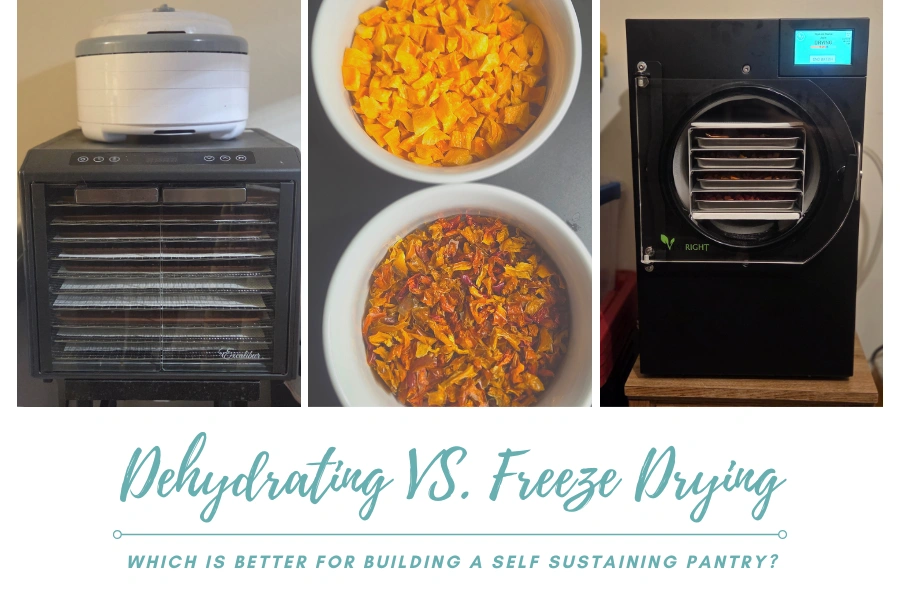
Dehydrating vs. freeze drying in a nutshell: Dehydrating is cheaper, faster, and a great entry point, but it can’t handle dairy, eggs, or fatty meats, and rehydrated texture is hit or miss. Freeze drying costs significantly more and takes longer per batch, but it preserves nearly anything, including full meals, dairy, and meat, with texture and flavor that come back almost perfectly. Most serious pantry builders eventually use both, just not necessarily starting with both.
Ask Yourself These Questions Before Buying Either One
This is the step most people skip, and it’s the reason they end up with the wrong machine sitting unused in a closet.
- Why do I actually want a self-sustaining pantry?
- Do I need quick, ready-to-eat meals, or am I fine cooking from scratch?
- Am I traveling, camping, or backpacking regularly?
- Is this about emergency food storage specifically?
- Am I trying to avoid running a fridge or freezer at all?
- Do I have a garden or bulk buys producing more than I can use before it spoils?
- What’s my budget right now, not eventually?
Your honest answers to these determine which machine actually fits your life, not which one has the better reviews.
Dehydrating: The Low-Cost Entry Point
My first dehydrator cost $2.50 at a thrift store, no settings, no bells and whistles, just a fan and some trays. I knew nothing about food preservation going in, but at that price there was nothing to lose.
Dehydrating turns out to be behind a lot of convenience foods you already buy: minute rice is just dehydrated cooked rice, instant coffee is brewed coffee with the water removed, onion and garlic powder are exactly what they sound like. That realization was the whole reason I got serious about making convenience foods myself instead of buying them.
What it’s genuinely good at: fruits, vegetables, grains, herbs, and powders. If you want the full how-to, temperatures, prep steps, and troubleshooting, I’ve got a complete beginner’s guide here, and a deeper breakdown on what actually holds up in long-term storage once you’re past the basics.
What it’s genuinely bad at: anything high in fat or dairy (milk, eggs, cream, butter, cheese, avocado, none of it dehydrates safely), and rehydrated texture can be hit or miss. At home with an Instant Pot or a good simmer, results are excellent. In a thermos while camping, food rehydrates fine but the texture, especially ground beef and some vegetables, stays a little chewy. It works, it’s just not identical to fresh.
Freeze Drying: The Ceiling Dehydrating Can’t Reach
After a while, I started asking a bigger question: could I build a pantry that didn’t rely on a fridge or freezer at all? That’s the reason I eventually added a freeze dryer, it does the things a dehydrator genuinely cannot.
Freeze-dried food rehydrates in seconds, in hot or cold water, and the texture and flavor come back close to fresh. It also handles the entire list dehydrating can’t: dairy, eggs, cheese, avocado, full cooked meals, and meat, including chicken, which never rehydrated well for me out of the dehydrator. So far, I haven’t found anything it can’t preserve.
The tradeoff is upfront cost and time per batch, which is really what this whole decision comes down to.
The Real Cost Comparison
- Entry-level dehydrator: around $80
- High-quality dehydrator (Excalibur 10-tray): around $400
- Small freeze dryer: $1,200-$3,000+
We bought our small freeze dryer on a Black Friday sale for $1,200, well under the usual price. That number scares a lot of people off, understandably, but the math shifts once you factor in fewer grocery trips, lightweight food for travel, and not needing to run a fridge or freezer around the clock. For our lifestyle, it paid for itself in ways that don’t show up on the price tag alone.
Time per batch:
- Dehydrator: 6-24 hours
- Freeze dryer: 24-36+ hours
Dehydrators are faster per batch, freeze-dried food wins on quality, texture, and what it can actually preserve.
So Which Should You Buy First?
Start with a dehydrator if:
- You’re on a tighter budget
- You cook most meals at home and can simmer or pressure-cook to rehydrate
- You’re keeping a fridge or freezer either way
- You want a low-risk way to try food preservation before committing more money
Go straight for a freeze dryer if:
- You want fast, ready-to-eat meals with minimal prep
- You travel, camp, or backpack often and need lightweight food
- You’re building a pantry meant to work with no fridge or freezer at all
- Budget isn’t the deciding factor
Most people who stick with food preservation long-term end up with both eventually, they solve different problems. But if you’re only starting with one, let your actual lifestyle answer the question, not the excitement of the bigger machine.
Whichever machine you start with, knowing how much to actually stock matters just as much as how you preserve it. I put together a free guide for exactly that, it’s called the From-Scratch Pantry Starter Guide, grab it below.
Where to Go Next
If a dehydrator sounds like your starting point, Dehydrating Basics walks through the actual process, and Dehydrating Food for Long-Term Pantry Storage covers what to store for years versus rotate through quickly.
If freeze drying is calling your name instead, Freeze Drying for Beginners is the equivalent starting point on that side.
And either way, figuring out how much food you actually need to stock matters more than which machine you buy first.
Final Thoughts
There’s no one-size-fits-all answer here. A dehydrator is usually the best place to start. A freeze dryer is a bigger investment that pays off if your lifestyle actually calls for it. Your pantry should support your life, not the other way around.
With love and adventure,
Mindy
📌Pin For Later

Related Reading
Final Thoughts
There is no one-size-fits-all answer. A dehydrator is often the best place to start. A freeze dryer is a powerful long-term investment. Your pantry should support your life, not the other way around.