

I want to tell you something about living inside Yellowstone that nobody puts in the brochure.
It is the most beautiful place I have ever been. And it is also one of the hardest places I have ever lived. Both of those things are completely true at the same time, and the longer we are here the more I understand that they are not in conflict with each other. They are just the full picture.
Most people only ever see Yellowstone in summer, or they dream about it that way. Blue skies and bison on the road and geysers steaming against green hillsides. That version is real. I live it every single weekend from the time the snow melts until the first hard freeze. Curtis gets his three days off now and we use every single one of them. Hiking trails we have not done yet. Camping spots we have been eyeing since fall. Off-roading on roads that spend the winter buried under snow. Driving through sections of the park we have been through a dozen times just because they never get old.
There is never a dull moment in summer here. Never. And I mean that in the best possible way.
But summer ends. And when it does, something shifts.
The Winter Nobody Warned Me About
The first winter I spent inside Yellowstone, I was not prepared for what it did to me.
In the summer I keep the door wide open. Fresh air moving through the apartment, Koda coming and going from the porch whenever she wants, the whole place feeling connected to the outside. Winter takes that away.
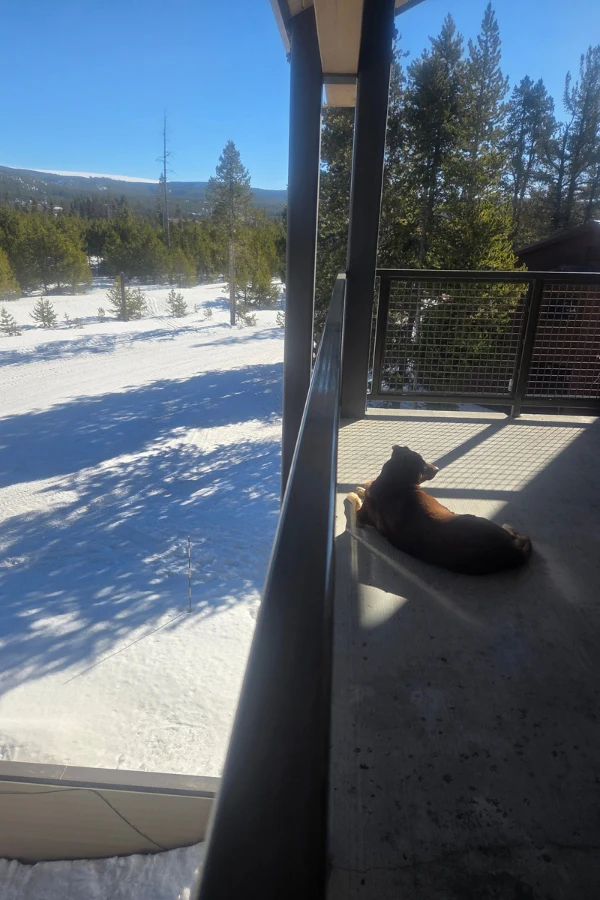
The door stays closed. Koda paces. Bedroom to living room, living room to bedroom, back again. I let her out on the porch with the door cracked so she can get back in on her own, and she stands out there for a few minutes, looks around at the same snow she has been looking at for months, gets bored, and comes back inside. She lays down for a few minutes. Gets back up. Wanders to the bedroom. Comes back to the living room and just stares at me with that look that means she is hoping we are about to do something more interesting than this.
And I want to tell her yes. I want to say let’s go. But outside is cold and wet and looks exactly the same as it has looked every single day for weeks. I do not mind being outside when we are actually doing something, hiking somewhere new, moving toward something. What gets to me is going outside just to be outside, walking the same paths, looking at the same things for the hundredth time in a row, and coming back inside having accomplished nothing except that the walls feel slightly smaller than before.
That was when I knew the winter was getting to me.
The isolation here is not like regular winter isolation. It is not the kind where you stay home for a few days and then the roads clear and you go back to normal life. The roads do not fully clear. The park closes sections that were open all summer. The seasonal staff leave in waves until the place feels hollowed out. And the freedom to just get in the car and go somewhere, anywhere, just to change the scenery, disappears in a way that is hard to explain until you have experienced it.
I want to be fair here though. The isolation is not inevitable for everyone who winters inside the park. If you have a snowmobile, winter looks completely different. Almost everywhere inside Yellowstone that allows oversnow travel is open to snowmobiles, which is most of the park. You can cover ground, see things, move. You can even ride out to where your vehicle is parked outside the park if you want to make the trip. The park becomes accessible again in a completely different way.
Curtis and I chose not to get one. It is a significant investment for a tool we would only use here, and once we leave Yellowstone it becomes something we have to store or sell or haul around with no practical use anywhere else we go. That is not how we think about gear. Everything we own has to travel with us and earn its place. A snowmobile does not fit that life.
That was our choice and it was the right one for us. But it does mean that winter here, for us specifically, means staying close. And staying close in a beautiful but unchanging landscape for months at a time is its own particular kind of hard.
It is not depression exactly. It is more like a slow gray settling. A cabin fever that builds so quietly you do not notice it until you are standing at a window watching your dog wag her tail at snow and wondering why you cannot feel what she feels.
The roads you can walk feel like the same four walls arranged differently. The views are stunning and unchanging at the same time. Beautiful and relentless. You start to wonder if the place owns you a little, or if you just forgot what it felt like to leave whenever you wanted to.
The Part That Made It Harder
That first winter, Curtis was carrying a lot.
He was running things largely on his own, putting in long hours, coming home tired in a way that went deeper than a normal tired. There is a specific kind of exhaustion that comes from being responsible for everything, and I watched it settle into him over those winter months. He was present in body but somewhere else entirely on the hard nights. We were both stuck in the same place but sometimes it felt like we were stuck separately.
I was working from home, which sounds like freedom until the walls start to close in and there is nowhere to go and the person you would normally turn to is running on empty too. The loneliness of that particular combination is something I did not expect and did not know how to talk about at the time.
I just kept moving forward because that is what you do. You make the food, you write the posts, you walk the dog in the snow, you wait for spring.
How Things Look Different Now
We are coming up on our second winter here and I will be honest: I am slightly dreading it.
Not because I do not love this place, because I do, genuinely and fully. But because I know what winter does here now. I know how the gray settles in and how the walls start to feel smaller and how the quiet shifts from peaceful to heavy without you noticing the exact moment it happened.
What is different this time is Curtis.
He has two other managers helping him now, he gets his full three days off and he comes home present, actually present, not just physically in the room. That one change makes more difference than I can explain. We are a team again in the way we have always been at our best. The two of us, making plans, going places and coming home tired in the good way, the way that comes from doing things you chose instead of things you had to.
Last winter I was waiting for spring alone even when he was sitting right next to me. This winter I think we will actually get through it together.
That matters more than the snow, the closed roads or the shortened days. That is the thing that makes the hard part survivable.
What Living Inside Yellowstone Actually Looks Like (The Practical Part)
I get questions about this a lot so let me answer them honestly, with one caveat: I can only speak from my own experience. Curtis and I are here year-round and our situation looks different from what most seasonal employees experience. I work from home and am not a park employee myself. What I know about seasonal staff life is observed from the outside, not lived from the inside.
With that said, here is what I know.
Housing inside the park depends on your role. Employees at the management level are typically provided an apartment. It is not fancy but it is a real apartment with a full kitchen, a living room, and actual privacy. That is how Curtis, Koda and I live here, the three of us, with a space we can actually cook in and make our own.
Seasonal employees live differently. They are assigned dorm rooms shared with another seasonal worker. Simple spaces, a bedroom and a bathroom, no kitchen access. Meals come from the Employee Dining Room, the EDR, which serves breakfast, lunch, and dinner seven days a week. From what I have seen and heard the food is decent and you never have to think about cooking, which is either a relief or a frustration depending on who you are.
Beyond housing and meals, the park puts real effort into keeping seasonal staff from going stir crazy. There are employee recreation areas with workout equipment and space to decompress. Organized activities including tour buses that take employees around the park and to events outside it, rodeos and local attractions. Photography workshops and other mini classes. An employee pub where you can play pool, order pizza, have a drink, and actually be around people.
Curtis and I do not participate in most of those things. He is in management and held to a different standard when it comes to socializing with staff, and honestly we are both people who prefer the quiet. Just the three of us out on a trail somewhere doing the things we love. We have never needed a crowd to have a good time.
For seasonal employees who come here young, social and looking for an experience, I think the setup is genuinely good. You get housing, meals, a community, and you are living inside one of the most remarkable places on earth. Some people only come for a summer, some come for a winter and some come for a season and end up staying for years.
The tradeoff is always the isolation and the limited freedom in the winter months. How hard that hits depends entirely on the person.
Where I Am Now
Right now, in this moment, I love it here.
I am genuinely, unreservedly busy in the best possible way. The blog, the camping meals I am testing, building and freeze drying for our next adventure, the snacks, the planning for every weekend trip, the unpacking and repacking and going back out again. Curtis has his days off and we are using them. Every single one.
I would not have it any other way. I mean that.
But I am honest enough to admit that I am watching the calendar. Summer does not last forever here and I know what comes after it now. I know the gray, the quiet and the way the walls start to feel smaller.
However, I think this winter will be better. Curtis being present makes everything better. And I know how to see it coming now, which is half the battle with anything hard.
We will get through it the same way we get through everything: together, with food we made ourselves, and a dog who still wags her tail at snow like it is the first time she has ever seen it.
That has to be enough. And honestly, it is.
With love and adventure,
Mindy
Have you ever lived or worked inside a national park? Drop a comment below. I would love to hear your experience.