

I felt genuinely silly the day I learned how to make self-rising flour. There are only three ingredients, and I already had every single one of them in my pantry. I hadn’t bought a bag of self-rising flour since.
If you’ve ever started a recipe, gotten to the ingredient list, and realized you don’t have self-rising flour on hand, this fixes that in about two minutes with nothing but a whisk and a bowl.
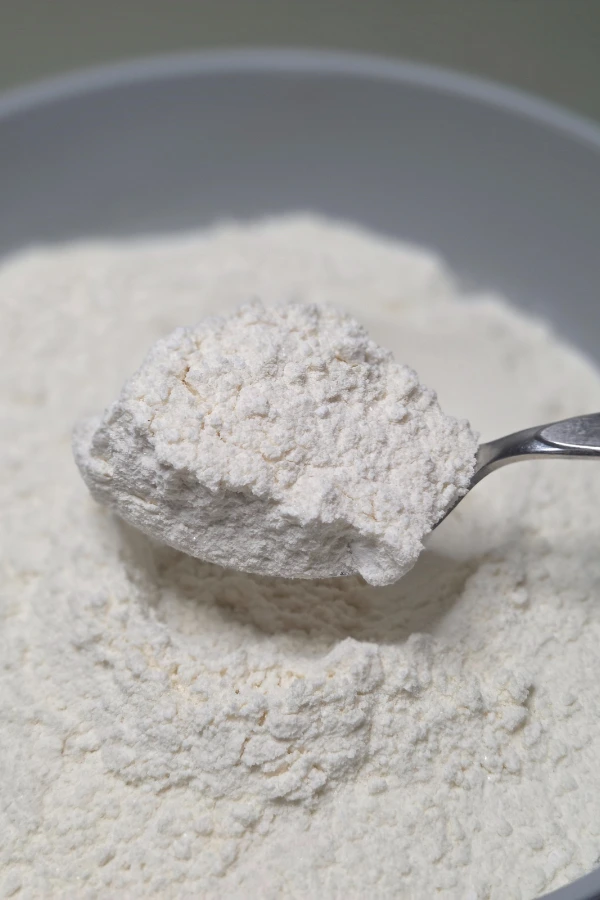
Self-rising flour in a nutshell: Combine 1 cup all-purpose flour with 1½ teaspoons baking powder and ½ teaspoon salt. Whisk together and use exactly as you would store-bought self-rising flour. That’s the whole recipe, and it scales directly for any amount you need.
What Self-Rising Flour Actually Is
Self-rising flour is just all-purpose flour with the leavening already mixed in. Instead of adding baking powder and salt separately every time a recipe calls for them, they’re already blended into the flour itself.
That’s genuinely the entire difference between self-rising and all-purpose flour. Self-rising flour rises on its own once it hits liquid and heat. Plain all-purpose flour needs a leavening agent added to a recipe, or nothing happens.
If you’re outside the US, you may know this as “self-raising flour,” same thing, different name depending on where you’re from.
The Recipe
Ingredients:
- 2 cups all-purpose flour
- 3 teaspoons baking powder
- 1 teaspoon salt
Instructions:
- Add all three ingredients to a bowl.
- Whisk thoroughly until fully combined, this matters more than it sounds like it would. Baking powder and salt need to be distributed evenly throughout the flour, or you’ll end up with inconsistent rise in your baked goods.
- Use immediately, or store in an airtight container.
That’s genuinely the whole process.
Scaling It to Any Amount
The ratio is always the same: for every 1 cup of all-purpose flour, add 1½ teaspoons of baking powder and ½ teaspoon of salt.
| All-Purpose Flour | Baking Powder | Salt |
|---|---|---|
| 1 cup | 1½ tsp | ½ tsp |
| 2 cups | 1 tbsp | 1 tsp |
| 3 cups | 1½ tbsp | 1½ tsp |
| 4 cups | 2 tbsp | 2 tsp |
| 6 cups | 3 tbsp | 3 tsp |
If a recipe calls for a specific amount of self-rising flour, just find the closest match here, or scale the base ratio yourself. It’s the same math every time.
What NOT to Use This In
This is the part most self-rising flour recipes skip, and it’s the part that can actually ruin a recipe if you get it wrong.
Don’t use self-rising flour in a recipe that already calls for baking powder, baking soda, or yeast separately. If a recipe already has its own leavening agents built into the ingredient list, adding self-rising flour on top means you’re doubling up, which can cause baked goods to rise too fast, then collapse, or leave a noticeably bitter, metallic taste from the excess baking powder.
If a recipe calls for self-rising flour in a yeast bread, some bakers omit the added salt from the self-rising flour itself, since yeast breads are usually salted separately and the extra can throw off the balance. Worth a taste-test on your first attempt.
Self-rising flour genuinely shines in recipes built for it from the start, biscuits, quick breads, pancakes, cobbler, and scones being the classics. If a recipe was written specifically for all-purpose flour plus separate leavening, that’s usually a sign to reach for plain flour instead.
Storage
Store in an airtight container in a cool, dry place, exactly like you’d store regular flour. At room temperature, it stays fresh and effective for about 3 to 6 months. Baking powder does lose potency over time, so if you’re making a big batch to keep on hand rather than mixing it fresh each time, use it within that window for the most reliable rise.
If you want it to last longer, add an oxygen absorber and vacuum seal the jar or bag. Removing the air slows the whole process down considerably.
If you like the idea of skipping specialty pantry items you can make from what you already have, I put together a free guide on building a pantry exactly that way. It’s called the From-Scratch Pantry Starter Guide, grab it below.
Frequently Asked Questions
Can I make this gluten-free? Yes, substitute a 1-to-1 gluten-free flour blend for the all-purpose flour, keeping the same baking powder and salt ratio. If your blend doesn’t already include xanthan gum, add about ½ teaspoon per 2 cups of flour blend to help it bind properly.
Is self-rising flour the same as self-raising flour? Yes, exactly the same thing. Self-rising is the term used in the US, self-raising is common in the UK, Canada, and Australia.
Can I use this in any recipe that calls for all-purpose flour? Not usually, unless the recipe already needs a leavening agent added anyway. Using self-rising flour in a recipe that isn’t built for it, like a roux, a pasta dough, or a recipe with no rise involved, can throw off both the texture and the flavor.
Why do I need to whisk it so thoroughly? Baking powder and salt are a tiny fraction of the total volume compared to the flour. If they’re not evenly distributed, you can end up with pockets of concentrated leavening in some bites and none in others, which shows up as uneven rise in the finished bake.
Final Thoughts
This is one of those recipes that saves an actual trip to the store, not just a few dollars. Once you know the ratio, you’ll never be stuck mid-recipe again, and you’ll probably wonder, like I did, why you didn’t figure this out years sooner.
With love and adventure,
Mindy
📌Pin for Later
Self-Rising Flour
Self-rising flour made from 3 pantry staples in about 2 minutes. No specialty bag, no store trip.
Ingredients
- 2 Cup All Purpose Flour
- 3 Tsp Baking Powder
- (Baking Powder Recipe)
- 1 Tsp Salt
- (This is the salt we use)
Instructions
- Add all ingredients to a bowl.
- Whisk thoroughly until fully and evenly combined.
- Use immediately or store in an airtight container.